
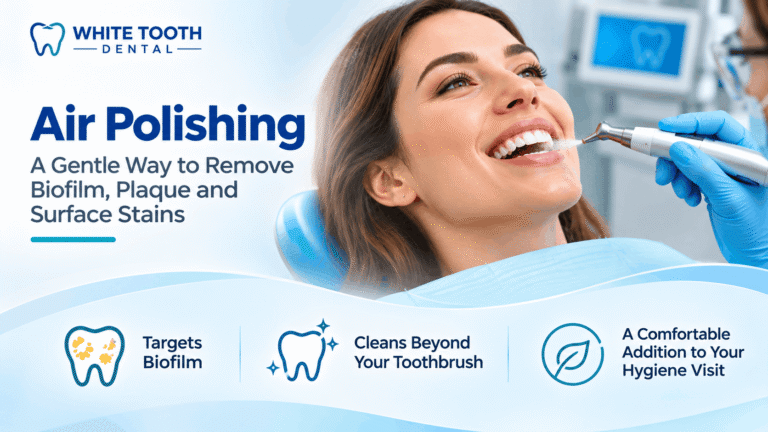

If your teeth still feel less than clean a few weeks after a hygiene visit, biofilm is usually the reason.
Air polishing is a method hygienists can use during a cleaning appointment to remove that film — along with plaque and everyday surface stains — using a spray of air, water, and fine powder rather than scraping alone.
First, what is biofilm?
Biofilm is a sticky, structured layer of bacteria that forms on your teeth every day. It is the soft film you can feel with your tongue when you wake up, before you brush.
Left undisturbed, it hardens into tartar (calculus) and contributes to tooth decay and gum irritation.
Brushing twice a day and cleaning between your teeth are essential — they are what keep biofilm from building up at home. But even careful home care has limits:
- A toothbrush cannot fully reach below the gumline, between tight contacts, or around braces, implants, and crowded teeth.
- Biofilm reforms continuously, including in those harder-to-reach areas, between visits.
- Once deposits have hardened into tartar, a toothbrush cannot remove them at all.
That gap between home care and a complete clean is what professional hygiene visits are for — and air polishing is one of the tools that can help close it.
What is air polishing?
Air polishing is a cleaning method that directs a controlled spray of air, water, and a fine powder at the tooth surface.
The spray lifts away biofilm, soft plaque, and surface stains from the teeth — including areas above and below the gumline that are difficult to reach with instruments alone.
How does it work?
1. Assessment. Your hygienist examines your teeth and gums and identifies where biofilm and stain have built up.
2. Air polishing. The spray is passed over each tooth surface, above and — where appropriate — below the gumline, lifting off biofilm, plaque, and surface stain.
3. Scaling and check. Any hardened tartar is removed with scaling instruments as needed, and your hygienist checks the result and reviews home care with you.
The air polishing step itself is usually quick. Total appointment time depends on what else your visit includes, such as an examination or X-rays.
Who is air polishing suited to?
Air polishing is commonly considered for people who:
- Have sensitive teeth and find conventional cleaning uncomfortable — many patients find the spray more comfortable, though experiences vary from person to person.
- Want surface stains addressed — for example, staining from coffee, tea, red wine, or tobacco.
- Have dental implants, crowns, or bridges that need biofilm removed from around them as part of ongoing maintenance.
- Wear braces or other orthodontic appliances, where wires and brackets make thorough cleaning at home harder.
- Are managing gum health and need biofilm removed below the gumline as part of their care plan.
Air polishing is not suitable for everyone or for every tooth surface.
Your dental team will assess your mouth and let you know if it is appropriate in your case, and whether another approach would serve you better.
For a regular hygiene visit in Toronto, explore our teeth cleaning and checkup service. You can also compare teeth scaling and regular cleaning to understand how each method supports oral health.
How is air polishing different from traditional scaling?
Air polishing and scaling do different jobs, and they are often used together in the same visit rather than one replacing the other:
| Air Polishing | Traditional Scaling | |
| How it works | A spray of air, water, and fine powder directed at the tooth | Hand or ultrasonic instruments applied to the tooth surface |
| What it removes | Biofilm, soft plaque, and surface stains, above and below the gumline | Hardened tartar (calculus) and heavier deposits |
| Where it reaches | Around implants, braces, and into shallow areas below the gumline | Along the tooth surface and under the gumline where instruments can access |
| What it doesn’t do | Remove hardened tartar on its own | Does not lift soft biofilm and stain in the same way |
In practice, many hygiene visits combine both: air polishing for the biofilm and stain, scaling for the hardened deposits.
Does air polishing whiten your teeth?
Not exactly — and the distinction matters. Air polishing removes stains that sit on the surface of the teeth, such as those from coffee, tea, and tobacco.
With those stains gone, teeth often look brighter and closer to their natural shade.
That is different from professional teeth whitening, which changes the underlying colour of the tooth.
If whitening is your goal, ask our team about whitening options at your visit — air polishing can be a sensible first step, but it is not a whitening treatment.
What should you expect at the visit?
During the appointment: you will feel a fine spray and hear the device as it works. Most appointments proceed tooth by tooth and do not take long for the polishing step itself.
Comfort: many patients find air polishing comfortable, including some who find scaling sensitive. If you feel discomfort at any point, tell your hygienist — the approach can be adjusted.
Afterwards: there is generally no recovery time, and you can return to your normal routine. Your hygienist may suggest avoiding strongly staining food and drink for a short period after your cleaning.
How often: air polishing is typically included as part of your regular hygiene visits, at the interval your dental team recommends for you.
Interested in air polishing at your next cleaning?
Air polishing is now available at White Tooth Dental in Bloor West Village.
For full details about the service, visit our dedicated service page, or call us at 416-766-4535 to ask whether it is right for your next hygiene visit.